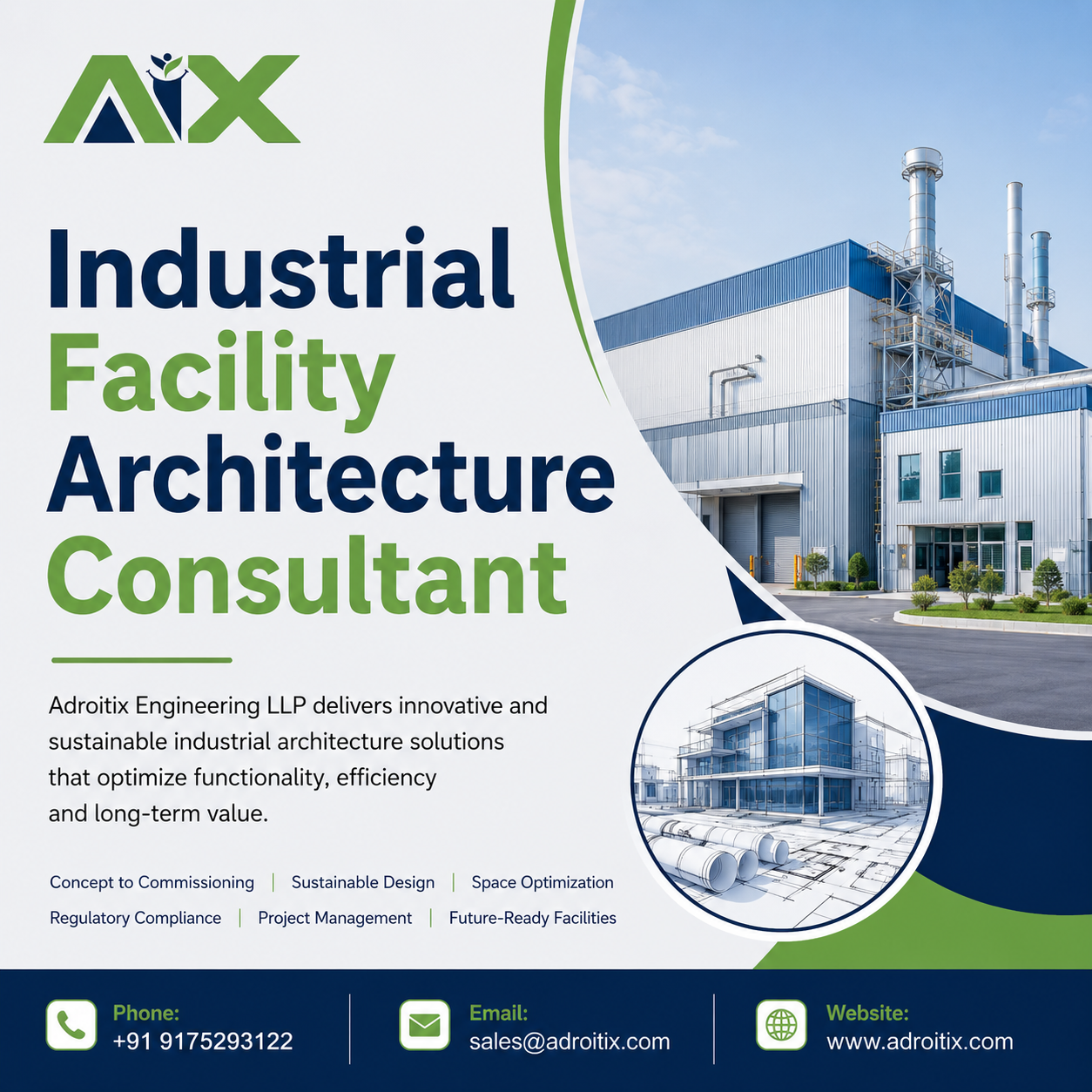
Build Future-Ready Industrial Facilities with Adroitix Engineering LLP
An industrial facility is expected to perform efficiently every single day for decades. Its design directly influences production efficiency, employee safety, equipment maintenance, logistics, and the ability to adapt to future business growth.
This is why businesses engage an Industrial Facility Architecture Consultant long before construction begins. Adroitix Engineering LLP specializes in designing intelligent industrial infrastructure where architecture, engineering, manufacturing, and operations work together seamlessly. Rather than simply creating buildings, the focus is on developing high-performance facilities that maximize efficiency, compliance, and long-term value.
The Five Principles of Successful Industrial Facility Design
Every industrial project has unique requirements, but the most successful facilities are designed around five core principles.
1. Designing Around Workflow
An efficient industrial facility begins with understanding how materials, equipment, products, and personnel move throughout the site.
When workflows are strategically planned, organizations benefit from:
- Faster production cycles
- Reduced material handling time
- Improved inventory management
- Better coordination between departments
A well-designed layout eliminates unnecessary movement before it becomes an operational challenge.
2. Planning Infrastructure That Can Grow
Industrial facilities should never be designed solely for current production requirements.
Adroitix Engineering LLP develops scalable infrastructure that supports:
- Future production lines
- Equipment upgrades
- Additional warehouse capacity
- Utility expansion
- Automation integration
Planning for expansion during the design...
Build Future-Ready Industrial Facilities with Adroitix Engineering LLP
An industrial facility is expected to perform efficiently every single day for decades. Its design directly influences production efficiency, employee safety, equipment maintenance, logistics, and the ability to adapt to future business growth.
This is why businesses engage an Industrial Facility Architecture Consultant long before construction begins. Adroitix Engineering LLP specializes in designing intelligent industrial infrastructure where architecture, engineering, manufacturing, and operations work together seamlessly. Rather than simply creating buildings, the focus is on developing high-performance facilities that maximize efficiency, compliance, and long-term value.
The Five Principles of Successful Industrial Facility Design
Every industrial project has unique requirements, but the most successful facilities are designed around five core principles.
1. Designing Around Workflow
An efficient industrial facility begins with understanding how materials, equipment, products, and personnel move throughout the site.
When workflows are strategically planned, organizations benefit from:
- Faster production cycles
- Reduced material handling time
- Improved inventory management
- Better coordination between departments
A well-designed layout eliminates unnecessary movement before it becomes an operational challenge.
2. Planning Infrastructure That Can Grow
Industrial facilities should never be designed solely for current production requirements.
Adroitix Engineering LLP develops scalable infrastructure that supports:
- Future production lines
- Equipment upgrades
- Additional warehouse capacity
- Utility expansion
- Automation integration
Planning for expansion during the design stage helps organizations avoid costly modifications in the future.
3. Making Safety Part of the Design
Safety delivers the greatest value when it is incorporated into the facility layout rather than added after construction.
Effective architectural planning improves workplace safety by providing:
- Clearly defined circulation routes
- Emergency access planning
- Adequate ventilation
- Safe equipment spacing
- Organized storage areas
- Better visibility across work zones
These design strategies reduce operational risks while improving workforce productivity.
4. Balancing Performance with Sustainability
Modern industrial architecture is expected to enhance operational performance while minimizing environmental impact.
Experienced consultants increasingly recommend:
- Energy-efficient building systems
- Natural lighting strategies
- Water conservation solutions
- Sustainable construction materials
- Efficient utility distribution
- Waste reduction planning
Sustainable engineering has become both an environmental responsibility and a practical business strategy that reduces long-term operating costs.
5. Building for Digital Operations
Today's industrial facilities are designed to support digital technologies from the very beginning.
Artificial Intelligence (AI), IoT-enabled devices, and digital monitoring platforms help organizations manage operations more efficiently.
Examples include:
- AI-driven maintenance planning
- Digital twin simulations
- Intelligent energy management
- Automated building controls
- Real-time facility monitoring
- Smart manufacturing integration
Designing digital infrastructure early makes future technology adoption easier and more cost-effective.
What an Industrial Facility Architecture Consultant Brings to a Project
Beyond preparing architectural drawings, Adroitix Engineering LLP coordinates multiple engineering disciplines to ensure every aspect of the facility functions efficiently throughout its lifecycle.
Key services include:
- Site and master planning
- Production layout development
- Space utilization analysis
- Utility coordination
- Compliance-focused infrastructure planning
- Expansion planning
- Sustainable building strategies
- Project coordination
This integrated engineering approach minimizes project delays while improving long-term operational performance.
Questions Every Business Should Ask Before Starting a Project
Before investing in a new industrial facility, organizations should evaluate whether the proposed design can answer several important questions.
- Can production capacity increase without major reconstruction?
- Will the facility support future automation?
- Is the workflow optimized from receiving through dispatch?
- Are utilities designed for long-term operational efficiency?
- Can maintenance activities be completed without disrupting production?
- Does the design accommodate changing business requirements?
If any of these questions remain unanswered, additional planning should be completed before construction begins.
The Next Generation of Industrial Infrastructure
Industrial architecture is rapidly evolving beyond conventional building design into intelligent, connected environments.
Future-ready industrial facilities are expected to feature:
- Modular construction methods
- AI-assisted facility management
- Digitally connected infrastructure
- Flexible manufacturing spaces
- Smart energy systems
- Sustainable engineering practices
- Automated logistics integration
These innovations help organizations improve productivity while remaining prepared for changing operational and market demands.
Conclusion
An industrial facility represents one of the most valuable long-term investments any organization can make. The quality of its design directly impacts operational efficiency, employee safety, maintenance costs, regulatory compliance, and future business expansion.
By partnering with Adroitix Engineering LLP, businesses gain access to experienced Industrial Facility Architecture Consultant services that combine architectural excellence, engineering expertise, sustainability, and digital innovation. Every project is planned to create facilities that are efficient, scalable, compliant, and ready for tomorrow's industrial landscape.
Frequently Asked Questions (FAQs)
1. What is the primary role of an industrial facility architecture consultant?
They plan and design industrial facilities that improve operational efficiency, safety, compliance, and long-term business performance.
2. Why is workflow planning important in industrial architecture?
Optimized workflows reduce unnecessary movement, improve productivity, and create smoother manufacturing and logistics operations.
3. How does industrial architecture support future business growth?
By incorporating scalable infrastructure, flexible layouts, and expansion-ready utilities that accommodate increasing production demands.
4. What technologies are influencing modern industrial facility design?
Artificial Intelligence, IoT, digital twins, automated building management systems, and smart manufacturing technologies are reshaping industrial infrastructure.
5. How can architecture improve workplace safety?
Through thoughtful layout planning, clear circulation routes, emergency access, ventilation design, and proper equipment spacing.
6. What is a digital twin in industrial infrastructure?
A digital twin is a virtual representation of a facility used to test layouts, simulate operations, and optimize performance before construction or expansion.
7. Why is sustainability becoming a priority in industrial projects?
Sustainable designs reduce operating costs, improve energy efficiency, minimize environmental impact, and support long-term business goals.
8. When should an architecture consultant be involved?
The ideal time is during the conceptual planning phase so strategic design decisions guide the entire project from the beginning.
9. What industries commonly require industrial architecture consultancy?
Manufacturing, pharmaceuticals, logistics, warehousing, food processing, engineering, automotive, and heavy industrial sectors all benefit from specialized industrial facility design.
10. What defines a future-ready industrial facility?
A future-ready facility combines scalable infrastructure, intelligent technologies, sustainable engineering, flexible layouts, and operational efficiency to adapt to evolving business needs.